

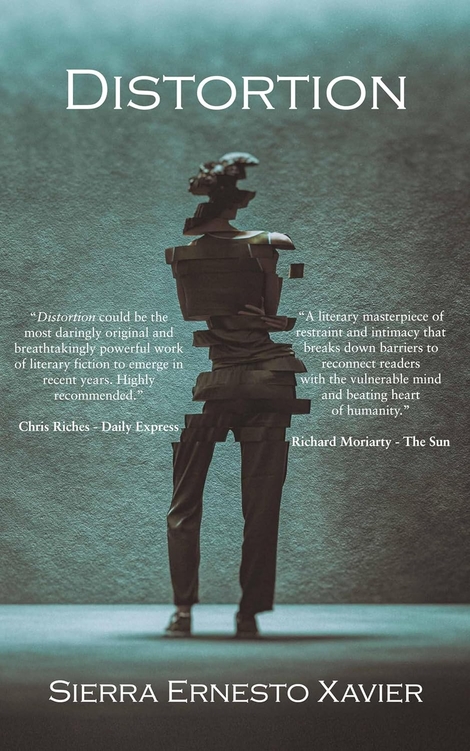
A searing exploration of identity, self-image, and unconditional acceptance, Distortion by Sierra Ernesto Xavier is a post-modern love story that upends both storytelling norms and the entrenched standards of beauty.
He has a facial deformity that has tortured him since birth; she suffers from scoliosis and bears the body-spanning scar to prove it. Overcoming a lifetime of internalized shame and the feeling of being a medical specimen is daunting for both of them, but as trust develops, their battle-worn walls begin to fall, allowing for expansive love and radical acceptance to grow.
Together, they explore the physical and psychological landscapes of their pain, comforting one another and gradually coaxing confidence from their respective depths of personal tragedy. Whether they are comparing notes on childhood bullies, swapping nightmarish tales of hospital stays, or delicately navigating each other’s insecurities in the bedroom, this patiently paced read is a slow-burning meditation on how our bodies inform our lives.
The story artfully touches on a broad range of subjects, from loneliness, the unique shape of individual trauma, and the cruelty of “normalcy” to chronic depression, the fickle nature of time, and the blurry boundaries of personal and private spheres. Scattered throughout the text are also vivid passages detailing surgical procedures and the alienating experience of healthcare for a non-traditional body. Taboo topics are broached with compassionate ease, demonstrating the author’s depth of understanding and empathy, as well as his intention for this book to be a source of catharsis and support.
Xavier expresses this poignant story through dialogue alone, relying heavily on natural imagery and the language of adoration to progress the plot and provide visceral detail for readers. While this structure welcomes a reader into the intimate spaces and interactions of the protagonists, it does present certain challenges, as it strips away traditional modes of narrative support – context, setting, placement in time, exposition, and so on. As a result, despite having the author’s lens focused so precisely on their words, it can be unexpectedly difficult for readers to connect and engage with the main characters.
There is also a notable redundancy in the exchanges, along with unnatural speech patterns that can undercut the authenticity of each character’s emotions. Some scenes feel more like poetic dramatizations than vulnerable discussions, and though these moments are dramatic and emotionally charged, the specific meaning of an exchange can be lost in the loosely built structure. There are also inconsistent levels of intimacy, as if the characters are either seeing each other for the first time, or they’re intimately familiar.
The novel is ambitious and provocative, but feels limited by its minimalist structure, non-linear style, and lack of a distinct plot arc; while its wisdom and insight into disability culture are notable, the book falls short of its full and undeniable potential. Even with its weaknesses, however, the novel is also highly original and instructive, imploring and effectively teaching the reader to explore their own unrehearsed humanity, for a uniquely soul-stirring work of psychological literary fiction.
Available At











Leave A Comment