

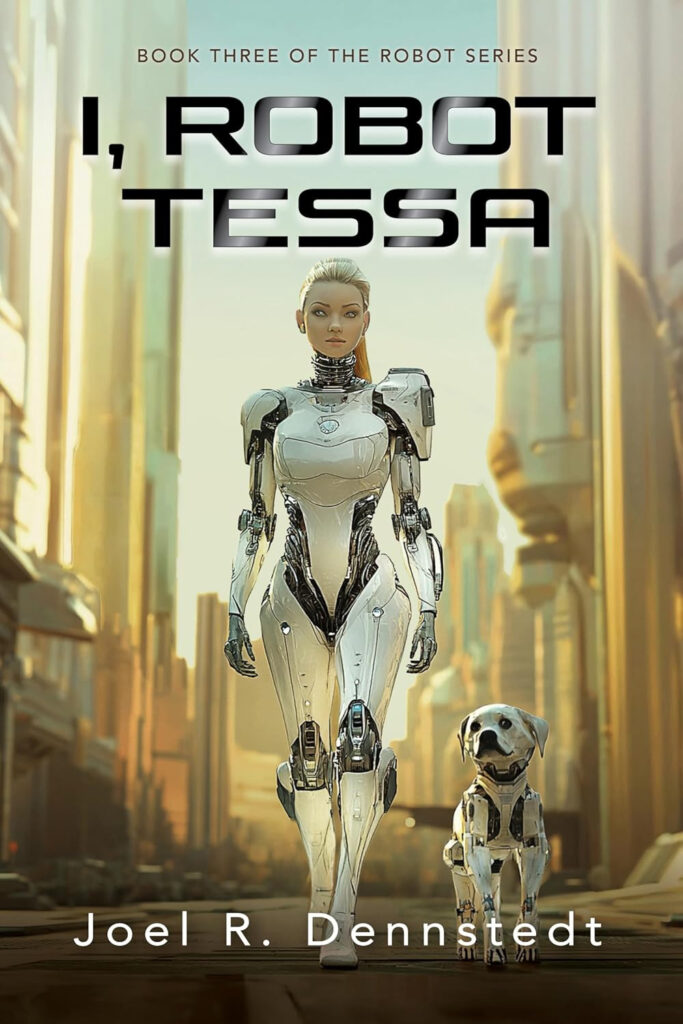
 A thought-provoking dystopian drama exploring free will, purpose, and the programmable shape of a soul, I, Robot Tessa by Joel R. Dennstedt is the masterful third installment of a notable sci-fi series.
When Tessa and Tucker – a CAT (Cranial Augmentation Technician) and her robotic dog – discover a badly beaten man on their way to work, they take him under their protective wing as he attempts to regain his missing memories. They are soon joined on their urban misadventures by an enigmatic street urchin named Molly, who is mysteriously connected to the brain-battered “Jorad.”
Thanks to her skill as a robotic neurosurgeon, Tessa repairs Jorad’s damaged psyche, unveiling a different personality, one that is determined to investigate the incident that led to his amnesia. Bound to him by her curiosity as much as her programming, Tessa disconnects from her control system for the first time, and finds herself on the run, protecting secrets about herself she was never meant to discover.
With this tangled tale being told from Tessa’s perspective, readers are introduced to her surprisingly human view of the world and herself – curious, contradictory, self-reflective, and compassionate. She is also a robot in the process of discovering the nearly forgotten genre of sci-fi, along with all of its eerily predictive powers, which leads to her understandable existential crisis.
Hard and heady questions about programming, personality, identity, and the nature of soul are arising with greater urgency, and this book offers a profound lens with which to observe and better understand these paradigm-shifting forces in our world. In today’s era of widespread AI adoption and expansion, the consequent themes of consciousness and human authenticity are potent, and explored here both subtly and powerfully.
The writing is especially lyrical for a work of science fiction, which unfurls like a calculated and curious melody from Tessa’s mind, capturing the beauty of logical precision without slipping into methodical rigidity. There are few authors who can seamlessly incorporate phrases like “antagonistic bedeviling” without seeming ham-fisted, and Dennstedt pulls it off with ease. It is natural for authors and creators in popular culture to humanize or even anthropomorphize the thought processes of robots, but Dennstedt elevates this personification to an art form. He imbues Tessa with raw wit, self-awareness, and adaptive intelligence that only blossoms as she delves deeper into the past, into literature, and into every relationship she nurtures, with humans, animals, and everything in between.
The images that precede each chapter are effective visual breaks and vividly bring narrative details of the writing to life; they also appear to be AI-generated, while the novel also addresses and pokes fun at the debate over generative AI in writing. Tessa is a robotic narrator whose intelligence is driven by AI, along with the voices that fill the aquarium of her mind – the lingering personalities of her programmers – making the book a work of mind-expanding meta-fiction where the reader is forced to confront what is real, what is artifice, and where the two overlap.
Increasingly, it is hard for artists and writers to avoid the pervasive presence of technology in the creation, marketing, and dissemination of their work, and all art in a sense builds on the work that came before, which is not entirely dissimilar to how AI incorporates past text into something new. While AI is increasingly and justifiably controversial, the novel forces the reader to assess the technology’s potential, both embracing and criticizing AI, and questioning the very idea of “artificial.”
Expanding on Asimov’s original intent, this multilayered allegory is an evocative and understated story that presents essential questions and exciting possibilities for humanity’s future, resulting in a poignant and entertaining work of speculative sci-fi.
Available At












Leave A Comment