

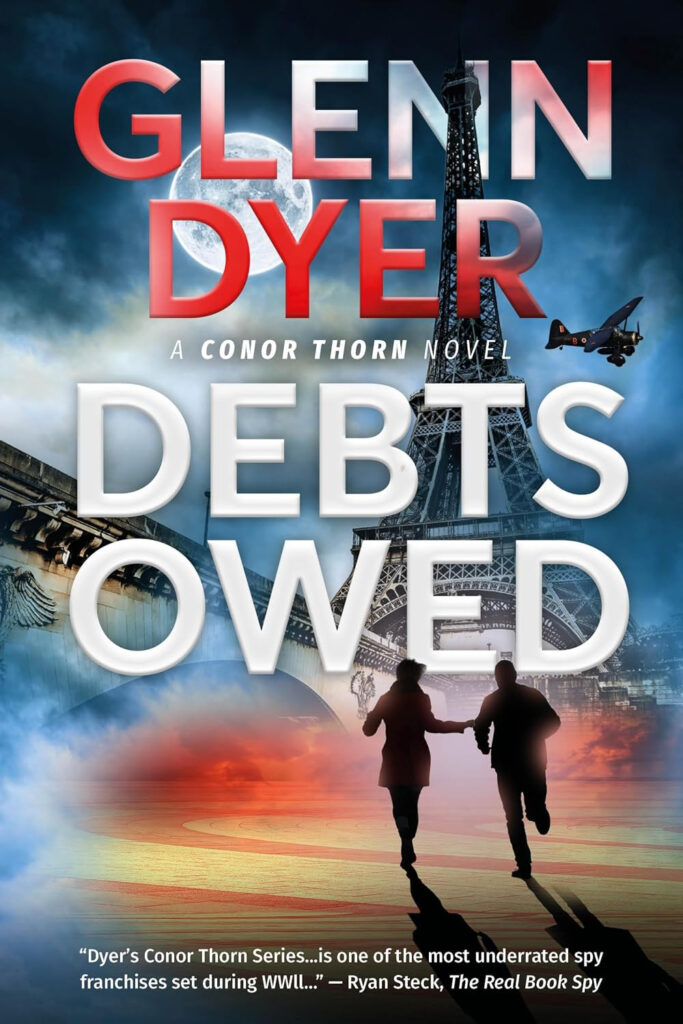
 A taut historical spy novel featuring the covert exploits of one resilient American operative, Debts Owed by Glenn Dyer sees the series’ relentless hero infiltrating the shadows of Vichy-controlled Paris in a deftly plotted World War II thriller.
Still haunted by grief and anger following the passing of his wife, Conor Thorn has found strength and purpose in serving the Allied Cause, carrying out vital missions across Europe, most recently at the side of Emily Bright, an invaluable agent moving seamlessly around the backrooms of British intelligence. When Emily is sent behind Nazi lines to reconnect with a missing intelligence operative, Conor is distraught at the thought of losing his new partner, so he wrangles his own mission that takes him across the Channel to occupied France.
As both agents pursue their unknowingly connected objectives, Nazi forces remain hot on their trail, as interested in disrupting their covert plans as they are in extracting top-level Allied secrets they both possess. From stuffy military headquarters and smoky London pubs to revolutionary Parisian safe houses and the viper pits of Nazi power brokering, Conor and Emily must leverage every ally and play each card right to have any chance at success, or extraction.
Dyer digs deeply into the nuances of loyalty on the ground in France, and the varying layers of resistance and solidarity across different fronts of the Allied war effort, helping this story stand out in a crowded niche of spy fiction. The perpetual tension and existential anxiety of the era are imbued in every page; the hurried exchanges of dialogue and the myriad duplicitous dealings in the story convey the mercurial atmosphere of mistrust, danger and courage that defined this watershed moment in the world, adding an immersive degree of realism.
A fascinating facet of the novel is the secret-keeping from one’s own allies, including Emily’s fluid shuffling between MI5, MI6 and the OSS, as well as Conor’s own mission initially being kept from the SOE and the SIS. These added layers of subterfuge and gamesmanship are cornerstones of the espionage genre, but WWII stories are frequently presented as a binary conflict of Allies vs. Axis, so the novel offers a unique depth of nuance and period detail.
At times, however, the story might be intricate to a fault – the writing can almost be too immersive, laden as it is with military jargon, abbreviations, historical figures, operational codenames, a kaleidoscope of characters, and the intense pace of wartime drama. A character list could be helpful at the start of the novel, particularly with all of the double-agency and dialogic deceptions that are part and parcel of the genre. The prose can also feel formulaic, at times, with familiar idioms and phrasing that make some lines come off as a nod to genre tropes, rather than stylistic or colloquial choices for the time period.
As the fifth book in the series, there is significant backstory and contextual relationships to unpack, so while Dyer does frontload the prose with exposition, it is hard to consider this a standalone read. Loyal readers will appreciate the interweaving of events from past installments and their consequences, but the full depth of the story will be lost on newcomers to the author’s work. Readers eventually fall into the rhythm, and it becomes more naturalized, but the initial reading experience can be overwhelming, even for those familiar with the players.
Aside from these small execution issues, this is a gripping, well-paced thriller led by a pair of compelling agents and a nail-biting plot, which further establishes the Conor Thorn series as a standout in the genre.
Available At















Leave A Comment