

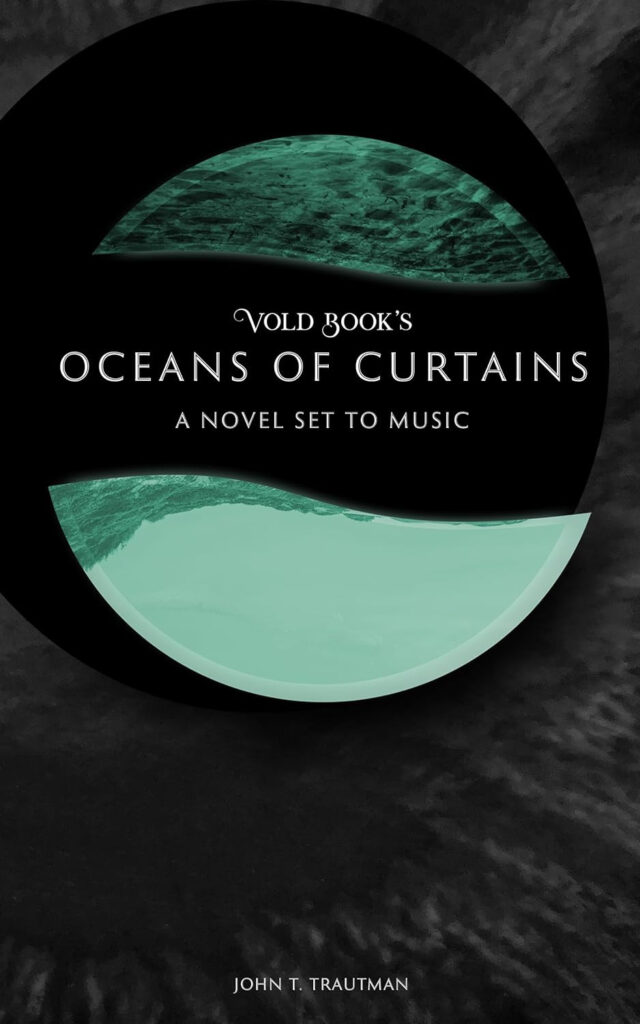
 What happens if a novel refuses to stay on the page? Vold Book’s Oceans of Curtains by John T. Trautman starts as something you think you recognize: a strange world, a cosmic romance, a quest across light and shadow. And then the audio element arrives, and the whole thing tilts. The background music, with its piano, ambient swells, drones, and drum machines, doesn’t behave like decoration. It behaves like a second narrator. That’s where the book stops being simply a novel and becomes a hybrid form that’s genuinely hard to file under one label.
On the surface, the novel is a story about two people caught in a vast metaphysical machinery, trying to stay human in a universe that treats souls and worlds almost like experimental material. You meet Pandara and Koravo, feel the tug of their connection, watch them move through Tristulle, Phalanx, the Pure Land, and the Realm of Forms, while invisible forces maneuver around them. As concepts stack up – Tristulle, Fotoa, the Electron Microstar, Abyssinia, the Oculus – you realize this is less a fantasy or sci-fi plot, and more a full cosmology.
The worldbuilding is thick and intentional: Tristulle’s dying glow, Phalanx’s strange bureaucracies, Ksevia’s ruins, the glass forest, the three-tiered bridge over Abyssinia. The cosmology of forms, shadows, and “higher” realities is not a casual backdrop; it’s the point. The story keeps circling questions of destiny, agency, love, and what it means for intelligence to outlive bodies and even worlds.
The human core is what keeps the story from floating away into pure abstraction. Pandara and Koravo’s relationship gives emotional gravity to scenes that could otherwise feel like expositional lore. The Baron von Brighten/Calliope sequence, for example, works as both plot and commentary: a fable about capitalism, tech myth-making, and the way people get pulled into systems they can’t quite ascertain. When the book leans into that double function – narrative on the surface, critique or metaphysics underneath – it’s at its strongest.
The big swing, though, is in the audio. This isn’t an “audiobook” in the usual sense. It’s an integrated score: piano themes, ambient beds, droning tones, and percussion patterns designed to sit under the text. The effect, especially in chapters 8 and 9, is cinematic; bureaucratic nightmare, whistleblowing, and institutional rot gain a nervous, pulsing energy when the rhythm section kicks in. Later, when the book moves into prayer, rupture, and grief, the slower piano and drones stretch emotions in a way the prose alone can’t quite do. The music gives the repetition and incantatory phrases a different weight; it feels more like being inside a long, carefully structured album than listening to someone read a book.
The prose itself is earnest and often striking, with lines that reach for big ideas without winking at the reader. The meta layer, with the Oculus, glitches, Rose on the line, and finally the author stepping forward to speak to Arkdemus and sign off with “INTELLIGENCE LIVES ON,” is a bold choice. It states plainly that this is a story about stories, and the survival of the mind through art and memory. A few of those tonal shifts are abrupt, but the intent is clear: to create a work of metafiction that also behaves as a kind of metamusic, creating its own genre that sits somewhere between metaphysical fantasy and visionary sci-fi, with a strong streak of philosophical allegory. Imagine His Dark Materials filtered through the cosmic awe of Hyperion and the layered, self-aware structure of Gene Wolfe’s Book of the New Sun.
That ambition comes with some trade-off – the explanatory passages on concepts like the Vortex of Time, xynipha, and the deeper metaphysical mechanics sometimes read more like a world bible than a novel. These elements are clearly crafted with deep thought and care, but they can slow momentum and risk losing readers who are more attached to character than a system. At times, repeated phrases and over-explained concepts blunt the impact. The reader could be trusted a little more, with the music doing some of that reinforcing work.
Overall, this is a very specific, very committed vision. It won’t necessarily be for readers who want a clean, single-genre narrative typical of fantasy. But for those who like densely packed cosmological fiction, and are willing to meet an opus that demands the attention of both a novel and a concept album, Vold Book’s Oceans of Curtains is exactly that: a complex, strange, carefully built transmission, where the soundtrack really does change the shape of the story, resulting in a devoutly unique work of both fiction and music.
Available At








Leave A Comment